Parking Lot Paving and Commercial Asphalt Repair in South Bend, IN
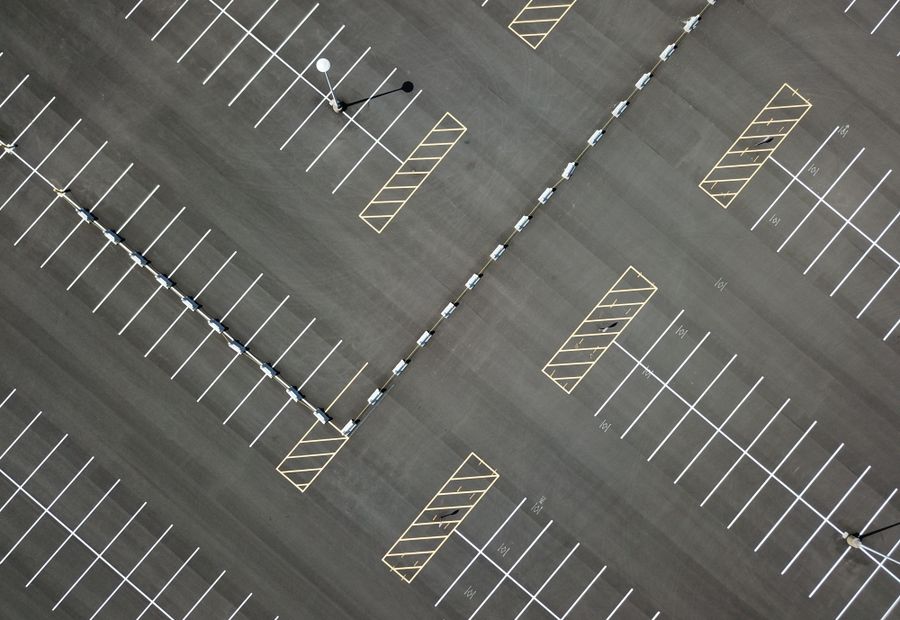
South Bend Driveway Paving is a paving contractor serving commercial property alongside its residential driveway work, which covers replacement, resurfacing, repair, new paving, sealcoating, gravel conversion, and driveway extensions. On the commercial side we pave and repair parking lots for property managers, HOA boards, churches, clinics, apartment buildings, and small industrial sites across South Bend, Mishawaka, Granger, and St. Joseph County, Indiana.
A lot gets built to the traffic that uses it. Stalls, drive aisles, and truck zones each get their own compacted stone depth and their own compacted asphalt depth, and the dumpster pad and delivery bay get the heaviest build on the site. Where the existing pavement is past overlaying, full-depth reclamation grinds the old asphalt and its base together into a new compacted base and we pave over that, which keeps the material on site instead of on trucks. Milling handles the transitions at entrances and at catch basins. That is a different order of work from a mat laid over a lot that is already breaking up around the drains.
Where Lots Actually Fail
Not in the middle of the parking stalls. They fail at the entrance where every vehicle turns, at the dumpster pad where a loaded truck sets its wheels in the same spot every week, along the delivery route, and around drains where water concentrates. Those areas are worth building heavy the first time.
Water Management
A lot is a large flat surface and the water has to leave it in a planned way. Grades run to catch basins, and those basins need their rims sitting at the finished surface rather than an inch above or below it. A lot that ponds is a lot with a base that is being soaked on a schedule.
Mill and Overlay
Where the base is sound and the surface is worn, milling a set depth off and paving back gives a new surface without raising the grade at the curbs, the entrances, or the drains. It is the standard mid-life treatment for a commercial lot and it is far cheaper than a rebuild.
Commercial Parking Lot Asphalt Repair
Most lots do not need a rebuild. They need repair before a small failure spreads. We saw-cut potholes and failed patches square, dig out the wet base, and fill them with hot mix compacted in lifts. Cracks get routed and sealed so water stops reaching the base. Then a sealcoat every few years protects the surface from sun and salt. A lot repaired on that cycle pushes the overlay years out. For the same work on a home driveway, see asphalt repair.
We build and repair lots across South Bend, Mishawaka, and Granger, including new parking lot construction on raw ground for new buildings.
Striping and Accessible Stalls
Layout goes back down after the surface cools. Accessible stalls, their access aisles, signage locations, fire lanes, and directional arrows all get set out to the requirements that apply to your property, and we confirm those with the authority that enforces them rather than copying the old layout by default.
Scheduling Around Your Tenants
We phase the lot so it never fully closes, and we run nights and weekends where the business needs its daytime. Boards and managers get the sequence, the closure map, and the price in writing before anything starts. Call (574) 555-0148 to walk the lot.
How thick should a commercial parking lot be?
Thicker than a driveway, and not uniformly thick across the lot. Car stalls can sit near the residential build. Drive aisles, entrances, dumpster pads, and loading areas carry trucks and need more compacted stone under them and more compacted asphalt over them. The right approach is to map where the heavy wheels actually go and build those zones up, rather than paying for one heavy section everywhere or one light section everywhere.
What is full-depth reclamation?
It is a way to rebuild a lot without hauling everything away. A machine grinds the existing asphalt together with the stone base underneath into a uniform blended material, which then gets shaped, compacted, and paved over. The old pavement becomes the new base instead of becoming trucking cost. On a large lot with a genuinely failed base it usually beats both an overlay and a full tear-out.
Can you pave the lot without closing my business?
Almost always, by phasing it. We split the lot into sections and work them one at a time, so entrances, accessible stalls, and enough parking stay usable throughout. Nights and weekends handle the rest for retail and office tenants. It takes longer overall than closing the whole lot, and we quote it that way so you can weigh the trade.
How long before we can drive and park on a new lot?
Traffic can generally go on once the mat has cooled through, often the same day or the next. Striping is the part that waits. Paint needs a clean, dry, cooled surface, so the layout usually goes down a few days after paving. On a fresh lot in hot weather we ask that trailers and dumpsters stay off the new surface for a good while longer than the cars do.