Asphalt Driveway Paving in South Bend, IN
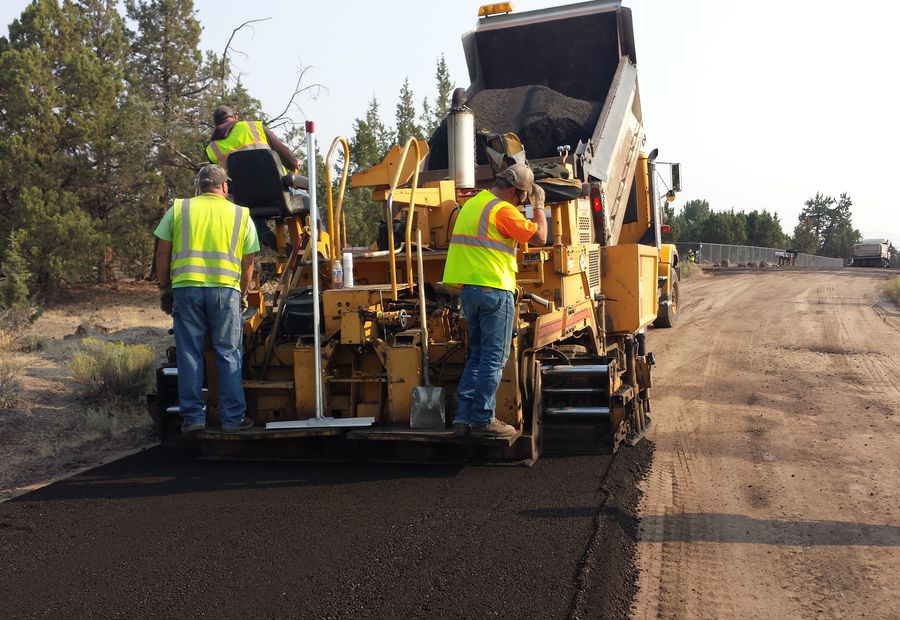
South Bend Driveway Paving builds new asphalt driveways on raw ground, and we also replace failed drives, resurface sound ones, patch and crack fill, sealcoat, convert gravel drives, add extensions and aprons, and pave commercial lots. As a paving contractor we work new construction, additions, rural properties, and lots that have never had a hard surface, across South Bend, Granger, New Carlisle, North Liberty, and St. Joseph County, Indiana.
A first-time driveway gets staked before anything moves, with the fall worked out on paper so water leaves the surface and does not run at the garage. Topsoil comes off, the subgrade gets shaped and proof-rolled, and soft ground gets geotextile fabric laid over it so the base stone and the clay stay separate. Then crusher run goes in, compacted in lifts, followed by a binder course and a surface course of hot mix. Contrast that with a drive built by grading the dirt flat, dumping a load of stone, and paving the same afternoon.
Layout Before Excavation
Where the drive runs, how wide it sits, where a car turns around, and where the water goes all get settled with stakes and string. Widths that look generous on paper feel tight with two doors open. Turnarounds save a decade of backing into a county road.
The Subgrade Decides the Driveway
Everything above the dirt is only as good as the dirt. We cut to grade, roll it, and watch for movement. Northern Indiana ground is clay-heavy glacial till, and clay holds water and gives under load when it is wet. Soft areas come out and get replaced with stone rather than being buried and hoped for.
Base Stone in Lifts
Six to eight inches of compacted crushed stone is the working residential figure, and more where trucks or an RV will use it. It goes down in layers and each layer gets rolled. Angular crushed material locks together under the roller. Round river gravel just rolls around under it and never locks.
Two Courses of Hot Mix
The binder course goes first, coarse and structural, roughly two inches after compaction. The surface course follows, finer and tighter, another inch and a half to two inches compacted. Both get rolled hot. Mix that cools before the roller reaches it will not reach density and it ravels loose stone for years afterward.
The Road End
Where a new drive meets a public road, the apron and any culvert are their own piece of work, and the right-of-way there belongs to the city or the county rather than to the homeowner. We confirm what is required with the correct office before we dig at that end. We do not guess and we do not promise an outcome.
Blacktop, Asphalt, and Pavers
Blacktop and asphalt are the same material. Blacktop is the older name for hot mix asphalt, and around South Bend people use both. Interlocking paver stones are a different product, laid by hardscape crews on sand. We pave asphalt. If you are pricing paver stones, we are the wrong call, and we will say so.
Choosing a Driveway Paving Company
Most driveway paving quotes give one number for the whole job. That number hides the two things that decide how long the driveway lasts. Ask every driveway paving company for:
- Square footage of the paved area.
- Compacted base stone depth, in inches.
- Compacted asphalt depth for each course, binder and surface.
- Whether the subgrade gets proof-rolled, and what happens to soft spots.
- Who handles the culvert and road tie-in, if there is one.
Our quotes list all five. If a driveway is replacing an old one rather than going on new ground, see asphalt driveway replacement. If the drive is gravel now, see gravel to asphalt conversion.
Curing and First Use
Cars can go on once the mat has cooled through, usually a day or two. Keep trailer jacks, kickstands, and heavy trucks off it much longer. Call (574) 555-0148 to get the ground looked at.
How deep do you dig for a new asphalt driveway?
Deep enough to fit the whole build plus the topsoil that has to leave. Under a residential drive that usually means about ten to twelve inches of excavation, giving room for six to eight inches of compacted stone and three to four inches of compacted asphalt in two courses. Soft ground, heavy vehicles, or a drive that trucks will use all push the excavation deeper. The number comes off what we find when the topsoil comes off, not off a brochure.
What is proof-rolling and why do you do it?
Proof-rolling means driving a loaded truck or a heavy roller across the shaped subgrade and watching the ground for movement. Anywhere it pumps, ruts, or springs back is a soft spot, and soft spots get dug out and replaced before a single stone goes down. It costs an hour. Finding those spots later, after the asphalt is on top of them, costs the driveway.
Do I need fabric under my driveway?
Only where the ground under it is soft or wet. Geotextile fabric is a separation layer laid between the subgrade and the stone. Without it, soft clay works up into the stone and the stone presses down into the clay, and within a few years the base you paid for is half dirt. On firm, well-drained ground it is an unnecessary line on a quote. We tell you which one you have.
How is a new driveway priced if there is nothing to tear out?
It prices per square foot like any asphalt job, and it usually runs less than a replacement because nobody is paying for demolition, loading, or hauling off the old surface. Excavation goes up though, since raw ground has to be cut and shaped from scratch. Long rural driveways move on how much stone gets trucked in, how far the paver has to travel, and whether a culvert and road tie-in are part of the job.