Asphalt Driveway Replacement in South Bend, IN
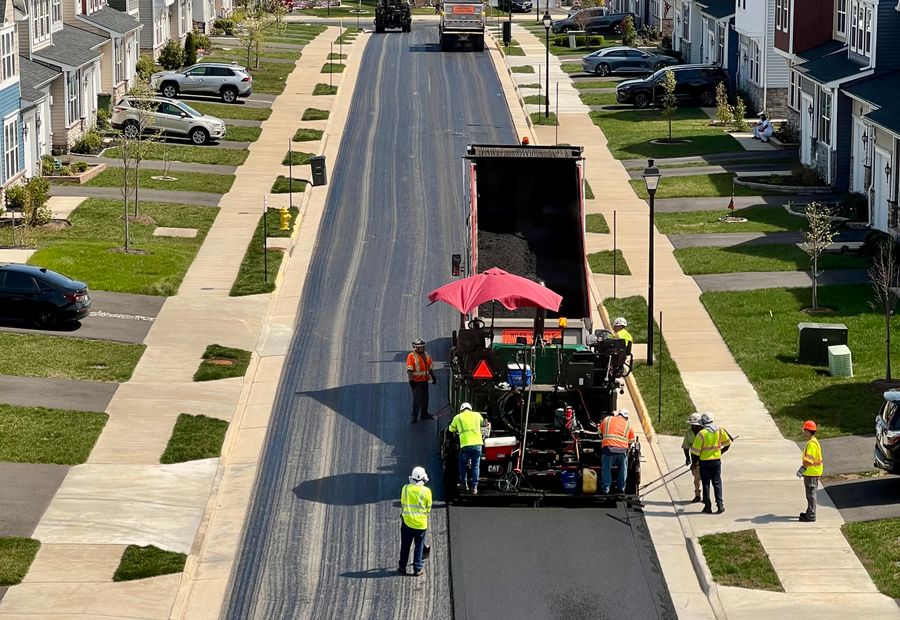
South Bend Driveway Paving is an asphalt paving contractor doing driveway replacement, resurfacing and overlays, patching and repair, new driveway paving, sealcoating, gravel to asphalt conversion, driveway extensions, and parking lot work. We serve houses, subdivisions, rentals, farm properties, and small commercial lots across South Bend, Mishawaka, Granger, Osceola, New Carlisle, and St. Joseph County, Indiana. Google calls the job an asphalt contractor. Homeowners call it the driveway guy.
A replacement goes back down on No. 53 stone, the dense-graded aggregate base sold by that name across northern Indiana, placed in lifts and compacted with a steel drum roller until it stops moving under the machine. Then a binder course of coarse hot mix, roughly two inches once compacted. Then a finer surface course over it. Your old driveway does not go in a hole out back. It gets loaded, hauled off, and crushed into reclaimed asphalt pavement that goes back into new mix. Compare that against two inches rolled over a surface that is already cracked through, with nothing touched underneath.
Alligator Cracking Means the Base Gave Up
A web of connected cracks across the surface is not wear. It is the asphalt flexing over ground that has started moving under load. Sealer, hot filler, and a fresh overlay all sit above that. New asphalt laid on it cracks in the same shape, in the same spots, within a few years, because the old cracks travel up through the new layer. That is reflective cracking and it is the reason a cheap answer costs twice.
What a Full-Depth Replacement Actually Involves
The old surface comes out by mill or by machine, down to dirt. The subgrade gets shaped and rolled, and soft spots get dug out rather than covered over. Stone goes in and gets compacted in lifts. The fall across the drive gets set at the stone, before any asphalt arrives, because pitch fixed later is not really fixed. Then two courses of hot mix, both rolled while they are hot enough to reach density.
The Grade Comes Back Where It Started
A replacement resets the height at the garage slab and at the apron. An overlay raises both by about two inches, which can eat the gap under a garage door and leave a lip at the street.
Which Fix Your Driveway Has Earned
Thin single cracks with a sound surface want crack filling and sealer. Two or three potholes in an otherwise solid drive want full-depth patches. A worn surface over a base that still holds, with water running off it, wants an overlay. Cracking in a web, ruts, standing water, edges gone, a drive that has dropped: that one wants replacement.
Price and Season
Asphalt prices by the square foot. Size, compacted depths, tear-out volume, grading, access for a truck, and drainage move the total. Paving runs roughly May through October here, since the plants close for winter. Call (574) 555-0148 and we will measure and price it in any month.
How much does a 2,000 square foot asphalt driveway cost?
Asphalt prices per square foot, so a drive that size lands in a wide band depending on what the job includes. Torn out and replaced full depth, expect the higher end. Paved for the first time on ground with nothing to remove, expect less. What moves it: the total size, how many compacted inches of asphalt go down, how deep the stone base runs, whether an old driveway has to come out and get hauled away, how much grading is needed, whether a triaxle and a paver can get in, and whether drainage has to be fixed. A replacement always costs more than a first pave, because tear-out and haul-off are real work with real trucking behind them. We give you a number for your driveway and not a national average.
What causes alligator cracking in a driveway?
The material under the asphalt has failed. Water got into the base, or the base was never deep enough, or it was never compacted properly, or the drive is carrying more weight than it was built to carry. The asphalt cracks into that connected web because it is flexing over ground that will not hold still. This is the one pattern that means replacement rather than resurfacing. Anything laid on top of it, sealer or filler or a new mat of asphalt, sits above the actual problem and comes apart along the same lines.
Is 2 inches of asphalt enough for a driveway?
Two inches compacted is the standard thickness for an overlay or for the surface course of a driveway. On its own it is not a driveway. A residential drive wants three to four inches of compacted asphalt, laid in two courses, over six to eight inches of compacted stone. Note the word compacted in both figures. Hot mix loses roughly a quarter of its depth as the roller works it, so two inches off the truck is not two inches in your driveway.
How long does an asphalt driveway replacement take?
Most residential replacements run two to four working days, and they are not consecutive hours of noise. Tear-out and haul-off take a day. Grading and the stone base take another, and the base often gets left to settle and prove itself. Paving is the fast part, usually a single day, because hot mix has to go down and get rolled before it cools. Weather moves all of it. Wet ground stops base compaction, and we would rather push a date than build on mud.